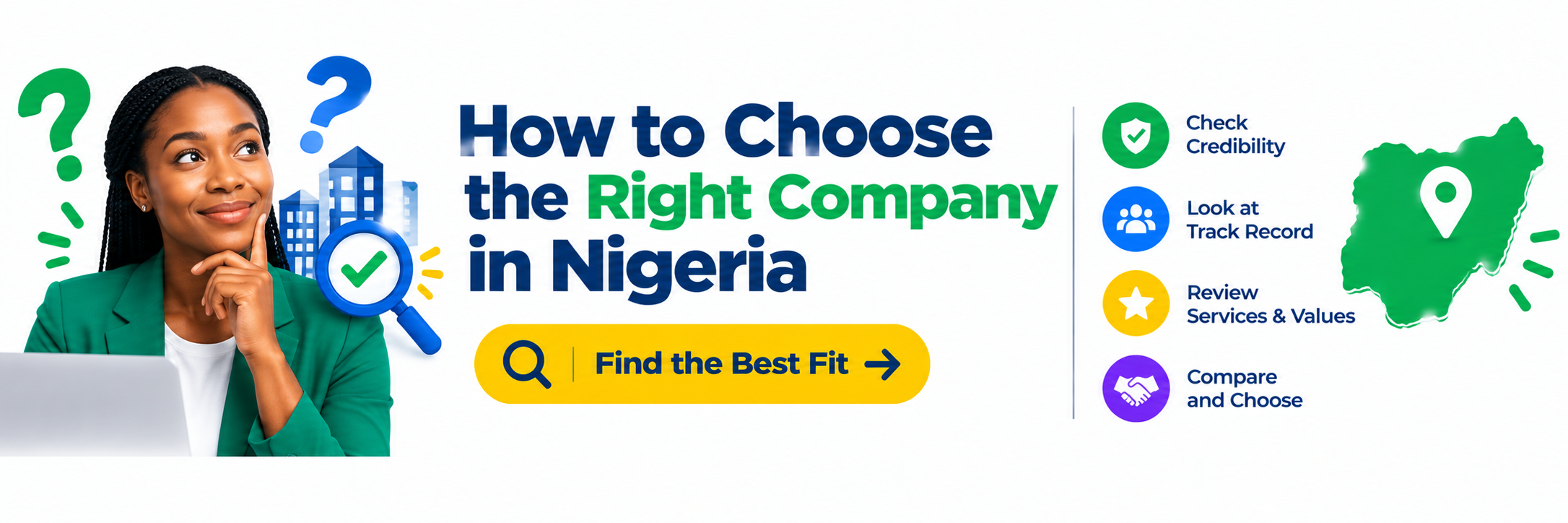
How to Choose the Right Company for Your Business Needs in Nigeria
Choosing the right company in Nigeria can make a significant difference to your business operations, personal projects, and purchasing decisions. Whether you need a logistics provider, marketing agency, construction company, technology partner, supplier, consultant, or professional service firm, the company you select should be capable of meeting your requirements.
With businesses offering different prices, service packages, experience levels, and delivery standards, comparing available options carefully is essential. A company with an impressive online presence may not necessarily be the right choice for your needs, while a smaller business may offer the expertise and attention your project requires.
This guide explains how to find suitable companies in Nigeria, assess their capabilities, compare quotations, identify potential risks, and choose a business partner based on evidence rather than appearance alone.
1. Identify Your Business Requirements
Before contacting companies, define what you need them to deliver. A clear brief makes it easier to identify suitable providers and compare their proposals fairly.
Start by answering these questions:
- What product, service, or business outcome do you need?
- What is the expected scope of work?
- What is your available budget?
- When do you need the work completed?
- Where must the company operate or deliver?
- Are there specific qualifications, standards, or technical requirements?
For example, if you need a digital marketing company, decide whether your priority is search visibility, lead generation, social media management, paid advertising, or a combination of services. If you need a logistics provider, clarify the type of goods, delivery locations, expected volumes, and timing.
The more clearly you define your requirements, the easier it becomes to identify a company that can meet them.
2. Search for Companies in the Right Industry
Begin with businesses that specialise in the service or product you require. General searches may return many unrelated companies, so include relevant industry terms and locations to narrow the options.
Examples of searches include:
- Construction companies in Nigeria.
- Digital marketing agencies for business growth.
- Freight forwarding and logistics companies.
- Information technology companies in Nigeria.
- Property management companies.
- Wholesale suppliers and distributors.
- Professional accounting and consulting firms.
- Business insurance providers.
Look beyond the first result. Compare several relevant companies and examine whether their services match your requirements.
3. Use Online Business Directories to Discover Companies
Online business directories can help you discover companies by industry, business category, and other available details. They provide an additional way to explore businesses beyond those you already know or those recommended by your immediate network.
When using a directory, review the information available about each company, including:
- Business name and industry category.
- Company description and services offered.
- Location and areas served.
- Contact details and enquiry options.
- Relevant images or examples of work.
- Additional information that helps you assess suitability.
Adspero is a hybrid customer acquisition and business visibility platform that helps businesses get discovered through business listings, SEO-focused visibility, advertising, and promotional opportunities.
Visit Adspero.com to explore business information and discover companies and service providers across Nigeria.
Remember that appearing in a directory does not automatically establish a company's qualifications or reliability. Conduct further checks according to the nature and value of the engagement.
4. Check Company Registration and Professional Credentials
For significant business transactions, confirm that the company has the appropriate legal standing and professional qualifications for the work involved.
Depending on the industry, you may need to check:
- Company registration details through the relevant official registry.
- Professional licences or regulatory authorisations.
- Relevant certifications and industry memberships.
- Tax or compliance documentation where applicable.
- Insurance coverage where the nature of the work requires it.
- References from previous clients or business partners.
For regulated industries, verify credentials with the relevant professional or regulatory body. For high-value contracts, consider obtaining independent legal, financial, or technical advice before proceeding.
Registration alone does not prove that a company is experienced, financially stable, or suitable for a particular project. It should be one part of a broader assessment.
5. Evaluate the Company's Experience and Previous Work
A company's relevant experience can help you determine whether it understands the challenges associated with your project. Ask about work it has completed that is comparable to what you need.
Useful questions include:
- Has the company handled projects of a similar size or complexity?
- Can it provide examples of relevant completed work?
- What process does it use to manage projects?
- Who will be responsible for delivering your work?
- How does it handle delays, errors, or unexpected problems?
- Can it provide references from suitable previous clients?
Where possible, speak with previous clients about their experience. Ask whether the company communicated clearly, met its commitments, managed changes properly, and delivered the agreed scope.
6. Compare Quotations and Service Packages
Price is an important factor, but the cheapest proposal may not offer the best value. Companies may quote different amounts because they include different services, materials, timelines, resources, and levels of support.
Request written proposals from suitable companies and compare them using the same requirements.
Check whether each quotation clearly states:
- The products or services included.
- The deliverables and expected outcomes.
- The total price and applicable additional charges.
- The project timeline or delivery schedule.
- The payment terms and milestones.
- The responsibilities of each party.
- The process for handling changes and additional work.
- Any applicable warranty or after-service support.
If one quotation is significantly cheaper than the others, ask why. The difference may reflect a smaller scope, different materials, a promotional offer, or exclusions that could create additional costs later.
7. Assess Communication and Customer Service
Good communication is important when working with a company. Even an experienced provider can create difficulties if it fails to explain its process, respond to questions, or communicate changes promptly.
During your initial discussions, assess whether the company:
- Understands your requirements.
- Answers questions clearly and professionally.
- Provides realistic timelines.
- Explains costs and contractual terms.
- Identifies potential challenges honestly.
- Provides a clear contact person for the engagement.
Pay attention to how the company handles difficult questions. A provider that explains limitations and risks clearly may be easier to work with than one that promises everything without discussing the details.
8. Review the Contract Before Making a Commitment
For substantial projects, a written contract helps establish what each party has agreed to do. It can reduce misunderstandings about payment, timelines, deliverables, confidentiality, and responsibility for problems.
Before signing, confirm that the agreement addresses:
- The identity of the parties involved.
- The scope of services and deliverables.
- The contract price and payment schedule.
- Deadlines and any conditions affecting delivery.
- Confidentiality and data handling where relevant.
- Ownership of work or intellectual property where applicable.
- Procedures for disputes, termination, and changes.
Do not rely solely on verbal assurances when substantial money or important business interests are involved. Seek independent legal advice if the agreement contains significant obligations or risks.
9. Identify Potential Warning Signs
Some warning signs deserve additional investigation before you select a company or transfer money.
- The company refuses to provide basic business information.
- Its identity or payment instructions cannot be reasonably confirmed.
- It pressures you to pay immediately without clear terms.
- It makes unrealistic promises about results or guaranteed returns.
- It cannot explain what its quotation includes.
- It provides references or examples that appear unverifiable.
- It repeatedly changes key terms without a satisfactory explanation.
- It discourages reasonable checks before a major transaction.
One concern does not automatically prove misconduct, but unresolved concerns should be addressed before proceeding. For major engagements, consider independent verification and appropriate contractual safeguards.
10. Choose a Company That Can Serve Your Location
Nigeria's business market spans different states, cities, and commercial centres. Some companies operate nationally, while others focus on specific locations or serve customers remotely.
Whether you are working with a company in Abia, Adamawa, Akwa Ibom, Anambra, Bauchi, Bayelsa, Benue, Borno, Cross River, Delta, Ebonyi, Edo, Ekiti, Enugu, Gombe, Imo, Jigawa, Kaduna, Kano, Katsina, Kebbi, Kogi, Kwara, Lagos, Nasarawa, Niger, Ogun, Ondo, Osun, Oyo, Plateau, Rivers, Sokoto, Taraba, Yobe, Zamfara, or the Federal Capital Territory, Abuja, confirm that it can deliver the service where you need it.
Ask about travel requirements, delivery charges, regional offices, remote support, and any geographical limitations. A company that is well suited to one location may not necessarily be able to provide the same service elsewhere.
11. Evaluate Long-Term Value and Business Compatibility
If you are selecting a company for an ongoing relationship, consider more than the initial transaction. A suitable business partner should be able to understand your changing requirements and maintain an effective working relationship.
Consider whether the company has:
- The capacity to handle your expected workload.
- A clear process for managing ongoing requests.
- Suitable communication and reporting arrangements.
- Transparent pricing for recurring services.
- A practical approach to resolving problems.
- The flexibility to support reasonable changes in your needs.
For recurring engagements, define performance expectations and review results periodically. A well-managed business relationship should provide clear responsibilities and a process for improving performance over time.
Frequently Asked Questions
How do I find a reliable company in Nigeria?
Search for companies in the relevant industry, compare written proposals, verify registration and professional credentials where appropriate, review relevant experience, and confirm the contract terms before committing.
Where can I discover companies offering services in Nigeria?
You can search online, consult professional associations, request referrals, explore industry networks, and browse business directories. Adspero.com provides another way to discover business information and service providers across Nigeria.
Should I always choose the cheapest company?
No. Compare the full scope, quality, experience, timeline, payment terms, and support included in each proposal. The most suitable choice is the one that meets your requirements and offers appropriate value for the price.
How can I verify a company's registration in Nigeria?
Use the relevant official company registry and verify professional licences or regulatory approvals where applicable. For important transactions, seek independent assistance if you are unsure how to interpret the information.
Can I work with a company located in another Nigerian state?
Yes, provided it can deliver the required service. Confirm its operational coverage, travel or delivery costs, communication arrangements, and ability to meet your timeline before signing an agreement.
Discover Businesses and Companies on Adspero
Choosing the right company begins with understanding your requirements and comparing providers using clear criteria. By checking experience, verifying important credentials, reviewing proposals, and agreeing on written terms, you can make more informed business decisions.
Adspero is a hybrid customer acquisition and business visibility platform that helps businesses improve their online presence through business listings, SEO-focused visibility, advertising, and promotional opportunities.
Visit Adspero.com to discover businesses and services across Nigeria or explore opportunities to improve your own company's visibility and reach potential customers.
Recent Posts




Get Your Business Discovered
Put your brand in front of thousands of Nigerian customers today.
Start Ads View pricing plans →