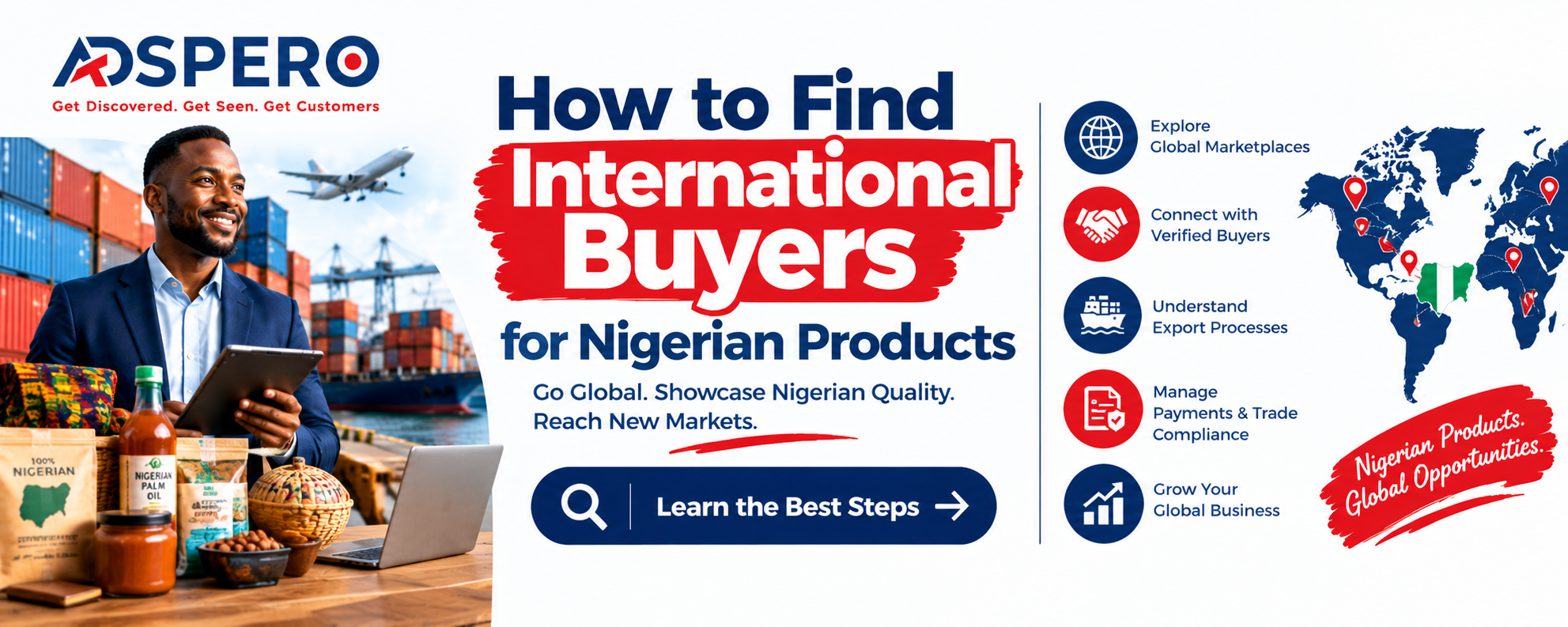
How to Find International Buyers for Nigerian Products
Finding international buyers can help Nigerian entrepreneurs expand beyond the domestic market and reach customers, distributors, wholesalers and manufacturers in other countries. Whether you supply agricultural products, processed foods, textiles, fashion items, handcrafted goods or manufactured products, your ability to identify suitable buyers can influence your export business's growth.
However, finding a company online does not automatically mean it is ready to buy. Successful exporters research market demand, identify the right decision-makers, verify potential customers and present clear commercial offers that address buyers' requirements.
This guide explains how to find international buyers for Nigerian products, where to search, how to approach overseas companies and how to improve your chances of securing genuine export enquiries.
1. Identify the Products You Want to Sell
Before searching for international buyers, define exactly what you intend to supply. Buyers typically search for specific products, grades, specifications and quantities rather than general offers from exporters.
Potential Nigerian export categories include:
- Agricultural commodities and selected food ingredients.
- Cocoa and related products.
- Cashew nuts and other suitable agricultural products.
- Sesame seeds and other commodity products.
- Processed foods that meet destination-market requirements.
- Clothing, textiles and fashion products.
- Handmade products, artwork and decorative items.
- Manufactured goods and selected industrial supplies.
These are research categories rather than guaranteed export opportunities. Confirm actual demand, competition, product eligibility and destination-market requirements before committing capital.
2. Choose Your Target Countries
Trying to find buyers in every country at once can waste time and marketing resources. Start by identifying markets where your product has a reasonable commercial opportunity.
Research the following factors before choosing a destination:
- Whether businesses in that country regularly purchase your product.
- The product specifications, quality standards and packaging expected by buyers.
- Competing suppliers and the prices they offer.
- Shipping costs, transit times and available freight options.
- Import regulations, documentation and potential restrictions.
- The likely order quantities and payment practices of your target buyers.
For example, an exporter supplying a food ingredient may target food processors, commodity traders or ingredient distributors. A manufacturer of fashion products may focus on retailers, wholesalers or specialist online stores.
3. Search Business-to-Business Marketplaces
Business-to-business marketplaces can help exporters identify companies that source products internationally. Depending on your industry, these platforms may allow you to publish product information, review buyer enquiries or contact suppliers and purchasing businesses.
When using these platforms, create a professional profile that clearly identifies your business and products. Include accurate specifications, available quantities, packaging details and contact information.
Do not assume that every enquiry represents a genuine buyer. Verify company identities, check the commercial details of each request and avoid sending money or sensitive documents to unverified parties.
4. Use Search Engines to Identify Importers and Distributors
Search engines can help you locate companies that already operate in your target market. Instead of searching only for general phrases such as “international buyers,” use specific searches related to your product and the type of business you want to reach.
Examples of useful search patterns include:
- Importers of [product] in [country].
- [Product] wholesale distributors in [country].
- [Product] manufacturers and industrial buyers in [country].
- [Product] purchasing companies in [city or country].
- [Product] retailers looking for suppliers.
- Companies importing [product category] from Africa.
Replace the bracketed terms with your actual product and target market. Review company websites, product catalogues and contact pages to determine whether the businesses are relevant to your offer.
5. Contact Importers, Wholesalers and Distributors Directly
Direct outreach can help you build relationships with companies that may have a genuine need for your products. The goal is not to send the same generic message to hundreds of businesses. It is to identify relevant prospects and explain why your offer may suit their purchasing requirements.
Before contacting a company, research:
- The products it currently sells or distributes.
- The countries and regions it serves.
- Whether it appears to purchase from external suppliers.
- The relevant purchasing manager, sourcing team or business owner.
- Its stated supplier application process, if available.
Keep your initial message brief, professional and specific. Introduce your business, identify the product you supply, mention your available capacity and ask whether the company is open to reviewing your product specifications or quotation.
6. Prepare a Professional Product Catalogue
International buyers need clear information before they can evaluate a supplier. A professional product catalogue helps you communicate your offer without repeatedly explaining basic details.
Your catalogue should include the following information where relevant:
- Product name and clear photographs.
- Detailed specifications and available grades.
- Country of origin.
- Available quantities and regular supply capacity.
- Packaging options and minimum order quantities.
- Indicative pricing or a quotation process.
- Production or preparation timelines.
- Relevant certificates or quality documentation.
- Business email, website and telephone contact.
Only include certifications and quality claims that you can verify. If a product requires testing or additional documentation, explain its current status accurately.
7. Build a Professional Website for International Buyers
A website allows overseas prospects to research your company before deciding whether to contact you. It can also support organic search visibility when your pages answer the questions buyers ask about your products.
Your website should clearly explain who you are, what you supply, where your products originate, which markets you serve and how prospective buyers can request a quotation.
Consider creating separate pages for important product categories instead of placing everything on one page. Use descriptive headings, accurate specifications and useful content rather than repeating the same keywords unnaturally.
Include a clear enquiry process, professional contact details and information about your sourcing or quality-control procedures where appropriate. Buyers should be able to understand your offer without struggling to find essential information.
8. Improve Your Business Visibility Online
International buyers may discover suppliers through search engines, professional networks, trade websites, business directories and online advertising. Maintaining accurate business information across relevant channels can make your company easier to find.
Adspero is a hybrid customer acquisition and business visibility platform that helps businesses get discovered through business listings, SEO-focused visibility and advertising opportunities. Businesses can explore relevant listing and promotional options to strengthen their online presence.
Visit Adspero.com to discover businesses and services across Nigeria or explore opportunities to improve your business visibility.
Online visibility is one part of an export marketing strategy. It should work alongside direct outreach, supplier relationships, market research and a professional website. No listing or promotional service can guarantee international orders.
9. Use LinkedIn to Find Purchasing Decision-Makers
LinkedIn can help exporters identify professionals who work in procurement, sourcing, supply chain management, wholesale distribution and business development.
Use relevant company and job-title searches to identify people whose responsibilities match your offer. Review their professional profiles and the company's business activities before making contact.
When reaching out, introduce yourself clearly and explain why you believe your product may be relevant. Avoid sending repeated messages or making unsupported claims about quality, capacity or pricing.
Keep your company profile current and share useful business information, product updates and credible evidence of your capabilities. Professional communication helps potential buyers evaluate whether you may be a suitable supplier.
10. Attend Trade Fairs and Industry Events
Trade exhibitions and industry events can create opportunities to meet importers, distributors, wholesalers and purchasing representatives. They can also help you understand market expectations and identify competing products.
Before attending an event:
- Research exhibitors and participating companies.
- Identify buyers who operate in your product category.
- Prepare samples or product materials where practical.
- Develop a concise company introduction.
- Prepare pricing information and product specifications.
- Arrange meetings with relevant contacts in advance where possible.
After the event, follow up with the people you met. Refer to your discussion, provide the requested information and agree on a practical next step.
11. Verify International Buyers Before Doing Business
Not every person claiming to represent an overseas company is a genuine purchasing representative. Exporters should carry out reasonable checks before committing goods, funds or confidential business information.
Consider the following verification steps:
- Check the company's official website and independently sourced contact information.
- Confirm the company's registered identity using appropriate official records where available.
- Verify that the person contacting you is connected to the company.
- Request a formal purchase order or written statement of requirements.
- Check that payment instructions match the agreed commercial arrangement.
- Use appropriate safeguards for significant orders.
- Be cautious about unusual advance fees, urgent payment demands or inconsistent company details.
A professional website, email address or business card is not conclusive proof of legitimacy. For large transactions, consider independent verification and qualified legal or trade advice.
12. Understand Export Pricing and Payment Terms
Your quotation should reflect the complete cost of fulfilling the order. Depending on the product and transaction, expenses may include sourcing, processing, packaging, local transport, inspections, documentation, freight, insurance and financial charges.
Before submitting a quotation, confirm the required quantity, product specifications, delivery location, shipping responsibilities and expected delivery schedule.
International commercial terms can clarify which party is responsible for particular shipping, insurance, clearance and delivery obligations. Make sure the terms are clearly agreed in the contract and understood by everyone involved.
Also agree on the payment method, currency, payment deadlines and procedures for resolving disputes. For unfamiliar buyers or substantial orders, consider suitable payment protections and professional advice.
13. Start With a Manageable Order
Securing a large international order may sound attractive, but accepting more business than you can supply can damage your reputation. Start with orders that match your verified supply capacity, working capital and ability to meet the buyer's specifications.
Before accepting an order, confirm the supplier's stock or production capacity, the relevant compliance requirements, the shipping plan and the payment arrangement.
Once you complete an order successfully, use the experience to improve your processes. Document costs, delivery times, buyer feedback and any problems that occurred. This information will help you prepare more accurate quotations and assess future opportunities.
14. Build a Nationwide Supplier Network in Nigeria
International buyers may seek different products from different parts of Nigeria. Building relationships with reliable producers, processors and manufacturers can help exporters identify suitable products and respond to buyer enquiries.
Potential supplier networks extend across Abia, Adamawa, Akwa Ibom, Anambra, Bauchi, Bayelsa, Benue, Borno, Cross River, Delta, Ebonyi, Edo, Ekiti, Enugu, Gombe, Imo, Jigawa, Kaduna, Kano, Katsina, Kebbi, Kogi, Kwara, Lagos, Nasarawa, Niger, Ogun, Ondo, Osun, Oyo, Plateau, Rivers, Sokoto, Taraba, Yobe, Zamfara and the Federal Capital Territory, Abuja.
The appropriate sourcing location depends on the product, production capacity, quality standards and transportation requirements. Verify suppliers individually rather than assuming that a particular location guarantees product quality or availability.
Common Mistakes to Avoid When Searching for International Buyers
- Contacting companies without checking whether they buy your product.
- Sending generic sales messages with no clear commercial offer.
- Quoting prices before calculating all relevant expenses.
- Making claims about certifications or supply capacity that cannot be substantiated.
- Failing to verify a buyer's identity and authority.
- Ignoring destination-market rules and product requirements.
- Relying entirely on one online marketplace or marketing channel.
- Failing to follow up professionally after an enquiry.
Frequently Asked Questions
How can I find international buyers for Nigerian products?
Research importers, wholesalers, distributors and manufacturers in your target markets. Use search engines, business-to-business platforms, professional networks, trade events and direct outreach. Verify each prospect and prepare a professional product offer.
Which Nigerian products attract international buyers?
Potential categories include agricultural commodities, processed products, textiles, handicrafts and manufactured goods. Demand depends on the destination market, product specifications, price, competition and applicable import requirements.
Can I find international buyers without travelling abroad?
Yes. You can research prospects, contact companies, attend virtual trade events and present product information online. Samples, inspections and other practical arrangements may still be necessary before a transaction is completed.
How do I know whether a foreign buyer is genuine?
Verify the company's identity and independently confirm its contact details. Check the representative's authority, request written purchase requirements and establish clear payment and delivery terms before committing to an order.
Do I need a website to find overseas buyers?
A website is not always essential, but it can help buyers assess your business, review product information and submit enquiries. A professional website combined with direct outreach and relevant online visibility can support your export marketing efforts.
Conclusion
Finding international buyers for Nigerian products requires a focused approach to market research, supplier selection, buyer verification and business promotion. Start with products you can supply reliably, identify companies with relevant purchasing needs and present a clear, accurate commercial offer.
Build your buyer network gradually, maintain professional communication and learn from every transaction. With dependable supply arrangements and a well-planned marketing strategy, your business can develop stronger relationships with customers in international markets.
Improve your online business visibility with Adspero. Visit Adspero.com to discover businesses and services across Nigeria and explore business visibility opportunities.
Recent Posts

Get Your Business Discovered
Put your brand in front of thousands of Nigerian customers today.
Start Ads View pricing plans →